
Neither Frightening nor Shameful. How to Confess in Order to Receive Forgiveness?
On the eve of the great religious feasts, many Christians go to confession. Even those who rarely come to church. Precisely for the feasts.
For one wants to greet the Nativity or the Resurrection with pure thoughts and a clear conscience. But why do we sometimes fear or feel ashamed to go to confession? How can we overcome the fear and do everything rightly so as to receive forgiveness? Why do we confess to a priest, who is just as human as we are? Does Putin have a chance at forgiveness, and is the secrecy of confession always inviolable? Is confession by telephone possible, and are priests at risk of professional burnout?
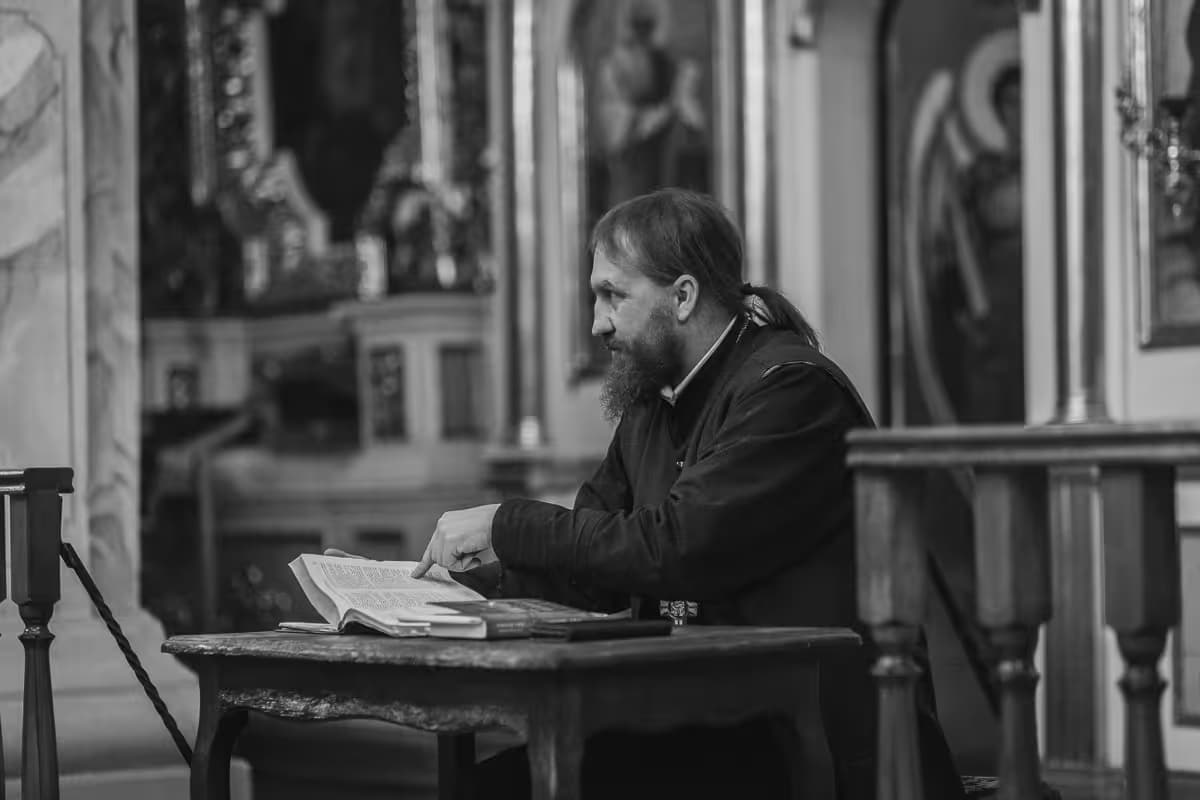
We discuss this with the abbot of the St. Nicholas Monastery of Zhydychyn of the Orthodox Church of Ukraine, Archimandrite Constantine (Marchenko).
Photo: Monasticism of Volyn
Let us begin with something simple: why must we confess to a priest? He is, after all, a person just like us.
In the Holy Scripture, which for every Christian is like a Constitution, in the Gospel of John, we read how Christ, after His resurrection, meets with His disciples. There are simple words there: «Christ breathed on them and said: “Receive the Holy Spirit; whose sins you forgive, they are forgiven; and whose sins you retain, they are retained.”» That is, the Lord, in creating the Church, gave a commandment to the apostles (and accordingly to priests as the successors of these apostles) to place the moral full stop in the matter of the struggle against sin. And this does not mean that the priest is in some way higher. We confess not to the priest, but in his presence. And he merely records and bears witness before God to the seriousness of the intentions of the person who has come to repent.
Today people increasingly turn to psychologists with their problems and troubles. Yet the Church has for more than two thousand years been helping people to overcome the problems within themselves — it is worth making use of this experience.
How often should one confess? Does the Church establish certain norms?
One must feel the need in one’s soul. For when we come to confession without need, can that even be called confession? That is why the key thing is the maturing of the human soul; the sense that something is emptying a person, taking away their peace and calm, that they cannot cope with something. And then the Church says: «It is hard for you, you have become confused. Come, let us stand before God, and you will tell of everything that pains you.» I, for instance, always begin confession with the question: «What hurts you most?» For when I hear that formalism — something like «I have sinned in word, deed, and thought, I repent» — I am quite at a loss. That is not confession.
Photo: Monasticism of Volyn
And if we speak of Church tradition, then in the Patriarchate of Constantinople, or in the Greek churches generally, the concepts of confession and Communion are very properly distinguished. Whereas among us a tradition has developed that before Communion one must necessarily confess. But this is not a requirement, but our local tradition — nothing more and nothing less.
As you said, the formal declaration «I am sinful — I repent» is not enough. How detailed should a confession be, so as not to be too much?
I can always sense when a person does not know what to say because they are nervous, and when they do not wish to confess sincerely but have come because, for example, their parents ordered them to. In the first case, a serious operation upon the human soul is needed. One must try not so much to draw the person out as to let them believe that this will help them, to remind them once more how the Lord loves them. Saint Theophan the Recluse said that sometimes even a prayerful sigh is itself a prayer. So too at confession: at times a person cannot find the words, but you see their trembling, their tears — and that too is confession.
What was the longest confession in your priestly practice?
Probably about an hour and a half. It was the confession of a monk. But laypeople should not take a monk’s confession as an example, for it is rather a monastic confession of thoughts. Life in a monastery and life in the world are different things, and the rules here are different.
Photo: Monasticism of Volyn
Priests have such periods — for example, during Great Lent or before the Nativity — when they sit for days in the confessional and listen to the faithful with their troubles and sorrows. Does this not threaten professional burnout?
Of burnout I cannot say, but there is fatigue. In our monastery, every Sunday and on feast days there are very many people. The priest hears confession throughout the entire service, about two hours. Sometimes there are nearly a hundred faithful coming to confession. Of course, we grow tired. All the more so when you are not merely a passive listener, but try to sympathize with the person, to encourage them, to help. You let their pain into your heart. This is hard. But I say jokingly: once you have called yourself a mushroom, climb into the basket. So if you have become a doctor — heal; if you have entered upon the priestly path — perform the sacred ministry.
Is it good to have one’s own priest, a spiritual father, with whom one confesses regularly?
Of course. It is like a family doctor who knows your illnesses, who knows how your body reacts to one medicine or another. It is the same with a priest. You let him into your life, and over time he understands without words when something is wrong with you.
Do Putin, Assad, or other tyrants have a chance at forgiveness?
Every person, as long as their heart beats, has a chance. The question is something else: will this person make use of their chance? As for such persons as Putin, here public repentance is needed. This was practiced in the ancient Church. And it concerns not only Putin — the people who gave him power and tolerate him are also guilty. And how are the corrupt officials in Ukraine any better than the aggressor — those who, in a time of war, when everyone is gathering aid for the soldiers, steal billions? They are the very same murderers. And I would very much not want these murderers with Ukrainian passports to come tomorrow to confession and have their sins absolved because they donated something to a church. No! They must atone for their sin before the whole people. Such persons have a chance to repent and receive forgiveness, but usually they never make use of it.
I think those same corrupt officials who steal from the budget really do donate to churches — and their sins are absolved. True, I am not certain of their sincerity, for usually they go on stealing afterward.
That is already a question for the priests who agree to this. I sometimes joke that perhaps it is so hard and takes us so long to restore our ancient monastery precisely because we have no dealings with such people. About 15 years ago we were offered a generous donation, but on the condition that it would be only a few percent of the sum that would have to be written off for construction. And we refused, because it is better to restore our holy site slowly but with a clear conscience and without dirty money.
The secrecy of confession. Does this rule have exceptions? For, on the one hand, we know how in Soviet times priests handed over their parishioners to the authorities — indeed, in Russia this is still practiced; and on the other hand, a serial killer may come to a priest and tell him that he has killed and will kill again. It is known that Metropolitan Pavlo Lebid of the UOC-MP heard the confession of the maniac Onoprienko and let him go with God, and that man then killed nearly fifty more people. Lebid himself spoke of this.
Confession is the holy of holies. The secrecy of confession must be inviolable. A priest faces very grave punishment for disclosure — at the very least a prohibition from performing the sacred ministry. But when it is a matter of a person being able to commit a serious crime, the priest must tell the bishop about it, and the bishop must then decide how to forestall the calamity. In the case of Onoprienko, I would have done exactly the same.
Photo: Monasticism of Volyn
Has the war affected people’s desire and need to repent and confess?
Yes. The way servicemen now confess is an example of what confession should be for everyone. Here there is pain, and tears, and sorrow for one’s mistakes. I have not heard more sincere confessions. When I come to some unit, the lads catch me by the hand — they ask for confession. Recently one serviceman called and says: «Father, surely God has forgotten about us.» And I begin to speak and to listen, because I understand that this may be his last chance to talk with a priest.
So this is confession by telephone? Is that possible?
Only in critical circumstances.
Were there cases when you managed to pull back a person who was a step away from the abyss?
It is the Lord who pulls them back. My task is to be an instrument in the hands of God. I will not forget one such case. A serviceman came who had been through Azovstal, had been wounded, had been treated. And the fact that he had had to kill lay as a burden upon his heart. He was not at all consoled when people said: «Well, you killed a Russian, after all.» It tormented him, ate away at him from within. We talked, before God. This 45-year-old man wept like a child, embraced me, and thanked me. I think now all is well with him. When you see such a result, you understand that the efforts are not in vain.
What would you advise people who do not dare to go to confession because they have had a similar unfortunate experience, are afraid, or feel ashamed?
There are doctors whom we too are ashamed to go to. But when the problem is already serious, when it hurts, we pull ourselves together and go. It is the same with confession. When it is already searing you from within, you do not think about shame. You must force yourself, overcome your pride, and come.
And for a confession to be good, one should be honest with oneself, sincere in the desire to repent and to atone for one’s sin. Saint Basil the Great said: «Foolish one, who will care for your soul if you yourself neglect it?» And yes, we will not become saints all at once. But we must try.
And then, with a pure heart and a clear conscience, we will greet the Nativity…
And it will remind Ukrainians that even in such a difficult time we are not alone. God comes to us; we are not indifferent to Him. Let us not give up. Let us believe in a miracle. Let us guard our humanity and our light. Christ survived — and we too will survive, all will be well with us, and we will become victors.
Photo: Monasticism of Volyn